

Note: This article may contain affiliate links. If you purchase a product through one of our links, we may earn a commission at no extra cost to you. We only recommend tools we believe can provide genuine value.
Semrush Review 2026: My Honest Experience
I’ve used quite a few SEO tools over the years, including lifetime-deal products and smaller SEO platforms.
But if you ask me which SEO tool I keep coming back to, Semrush is still my favorite overall.
Not because it has the biggest feature list or because every feature is perfect. I like it because it gives me many of the tools I need to run and improve a real website in one place.
For my workflow, I mainly use Semrush. I use it for site audits. I use it for on-page SEO. I use it for keyword research. I use it for competitor research. I use it for content work
I also use AI to create an initial Article draft and then work on the content myself. When I need to make the writing simpler and easier to read, I use Semrush’s content tools as part of that process.
That’s what this Semrush review is really about.
I’m not going to tell you that Semrush is perfect or that everyone needs to pay for it. Instead, I’ll explain how I use it, where it shines, when it can feel expensive, and who should consider it.
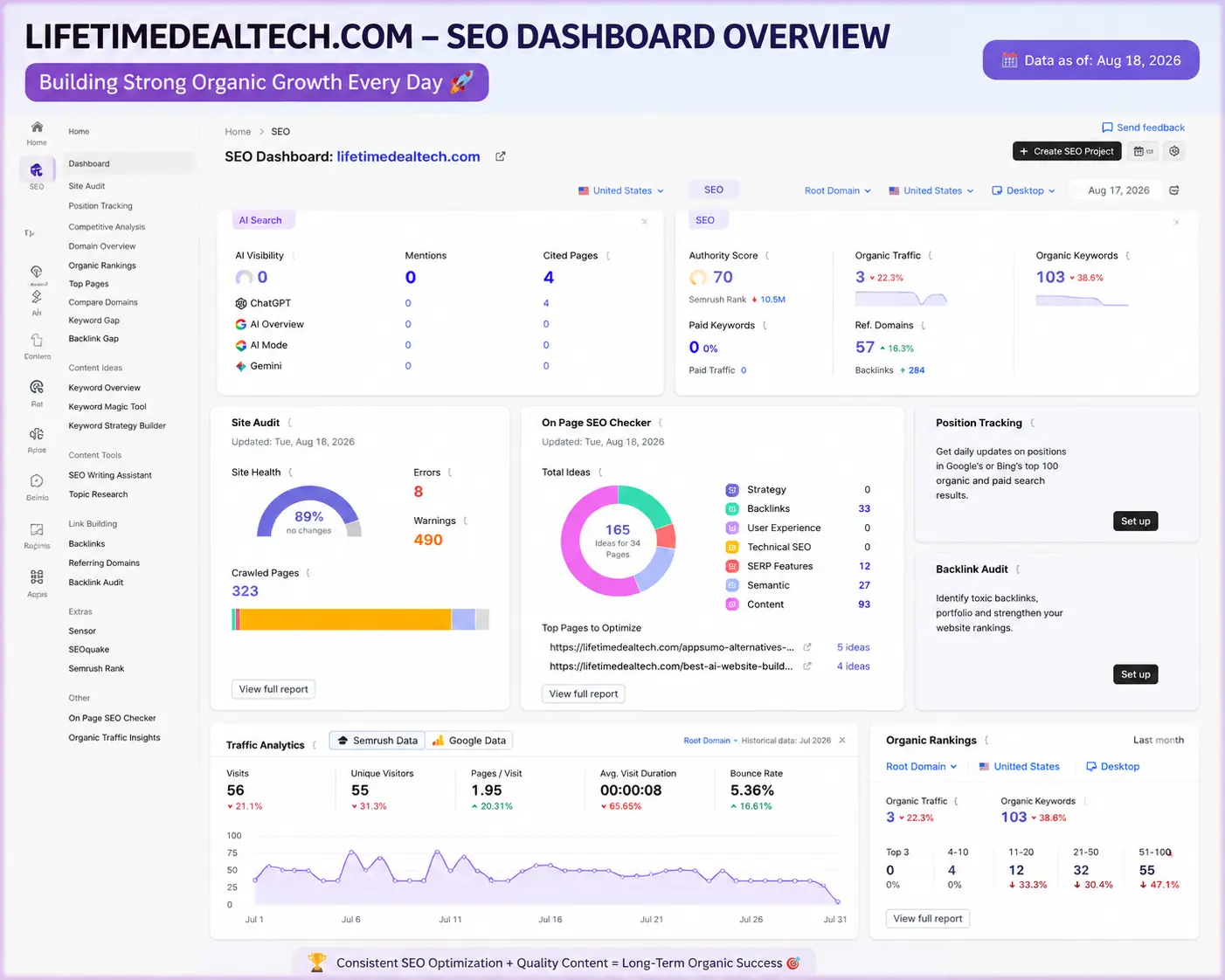
What Is Semrush?
Semrush is an all-in-one digital marketing and SEO platform. It helps site owners, marketers, agencies, and businesses. Users can research keywords and analyze competitors. They can audit sites, track rankings, and manage backlinks. It also helps improve content.
The SEO Toolkit includes tools for keyword research. It also includes tools for competitor research. You can use it for rank tracking. It supports backlink analysis. It includes tools for technical SEO audits. It also helps with on-page optimization.
That sounds like a lot, and honestly, it is.
When I first started using SEO software, I didn’t need 50 different features. I mainly wanted answers to simple questions:
- Why is my page not ranking?
- Are there technical SEO problems on my site?
- Which keywords should I target?
- What are competitors ranking for?
- Which pages need improvement?
- Is my content actually optimized?
Semrush gives me a way to investigate most of those questions without jumping between several different platforms.
Looking for a cheaper SEO alternative? If Semrush feels too expensive right now, read my guide to the 7 Best Ahrefs Alternatives in 2026. In it, I compare cheaper SEO tools and lifetime deals.
Why I Keep Coming Back to Semrush
There are plenty of cheaper SEO tools available.
Some are excellent for one specific job. Some are lifetime deals that make sense if you want to avoid another monthly subscription.
I use those tools too.
In fact, I actively look for lifetime deals because I don’t like paying monthly for every tool I need. If I can buy a useful tool once and keep using it, that makes sense for a small website or an independent creator.
But I don’t think every lifetime deal can replace Semrush.
My approach is simple. I use lifetime tools when they make sense. I also keep Semrush because I want deeper SEO research and competitor data in one place
For me, that’s the biggest reason Semrush remains my favorite.
If you’re interested in building a more affordable SEO stack, you can also check my guide to the best lifetime SEO tools for 2026.
What I Actually Use Semrush For
I don’t use every Semrush feature every day.
My actual workflow is much simpler.
1. Site Audits
One of the first things I do when working on a website is run a site audit.
Technical problems are easy to ignore when you’re focused on publishing content. But broken links can make SEO harder than it should be. Crawl issues can also cause problems. Duplicate content can hurt SEO. Missing metadata can make it harder too. Other technical problems can create issues as well.
Semrush Site Audit crawls a website and highlights technical and on-page issues that may need attention.
I don’t blindly fix every warning, though.
That’s important.
SEO tools can generate a huge list of issues. Some matter a lot, while others are minor.
I prefer to look at the issue, understand why it exists, and then decide whether it actually needs fixing.

2. On-Page SEO
Another area I use Semrush for is on-page SEO.
Once I have a target keyword, I don’t want to simply repeat that keyword throughout the article.
I want to understand the topic properly.
That means you should look at related terms. You should also consider search intent. Review competing pages. Check the content structure. Identify weak spots in the current results.
Semrush provides on-page SEO analysis and recommendations that can help identify areas for improvement.
I still make the final decisions myself.
That’s important because SEO tools don’t understand every article the same way a human reader does.
A tool can give you suggestions.
You still need to decide what actually makes sense for the reader.
3. Keyword Research
Keyword research is another reason I keep Semrush around.
Before I write an article, I want to know if people are searching for the topic. I also want to know how competitive the space is.
Semrush’s Keyword Magic Tool and other keyword research features help you find keyword ideas and related searches. They also show intent signals and opportunities to target more specific terms.
I don’t simply pick the keyword with the biggest search volume.
For a smaller website, that can be a mistake.
Sometimes, a low-volume keyword with clear intent is more realistic than competing for a big, generic keyword.
That’s especially important when you’re building a newer site.

4. Competitor Research
This is probably one of my favorite parts.
Sometimes I don’t need another article idea.
I need to understand why another website is ranking while mine isn’t.
That’s where competitor research becomes useful.
Semrush can help you analyze competitors’ organic rankings, top pages, keywords, backlinks, and keyword gaps. Its Keyword Gap tools can also compare competitors to find terms they rank for that you may be missing.
I find this useful when planning content.
Instead of guessing what to write next, I can look at competitors and ask:
What are they getting traffic from that I haven’t covered yet?
That question alone can produce some useful content ideas.
5. Content Research and Optimization
I also use SEO tools during the content creation process.
My workflow isn’t:
AI → Publish → Hope Google likes it.
I usually start by researching, creating a draft, and then working on the article myself.
AI can help me write a first draft faster. But I still rewrite sections and add my own experience. I also simplify sentences and remove extra parts. I make sure the article answers the reader’s question.
Semrush also offers content-focused tools to support topic research, content planning, and optimization.
For me, that’s where SEO software becomes useful rather than just being a keyword database.
How I Keep My Writing Clean
I use the Semrush Simplify tool to streamline my drafts effortlessly. It cuts through complex phrasing and refines my content in seconds, making my posts much easier to read and digest.
Like… ⇓

Semrush vs Lifetime SEO Tools
This is something I think my readers will want to know.
If you run a site like mine, should you pay for Semrush when lifetime SEO deals are available?
Sometimes yes. Sometimes no.
A lifetime deal can be a great choice if you only need a specific feature.
For example, if you mainly need an SEO audit tool, you may not need a huge all-in-one platform.
I’ve reviewed tools like SiteGuru that focus heavily on SEO auditing and prioritized recommendations.
I’ve also covered other SEO-focused lifetime tools, including SEO Generator.
These can make sense when your needs are specific.
But you may want a single platform for all these tasks. You can do keyword research, competitor research, site audits, rank tracking, backlink research, and content research there. Semrush is much harder to replace.
That’s why I personally keep using it.

What I Like About Semrush
After using it for my own work, these are the biggest positives for me.
Everything is connected
I don’t have to move between five different websites just to research a topic.
Strong competitor research
This is one of the areas where I think Semrush really earns its place.
Useful site auditing
The audit system helps me identify technical and on-page problems that I might otherwise miss.
Good for content planning
Keyword and competitor data can help turn random article ideas into more focused content plans.
Useful for serious SEO work
If you’re actively trying to grow an organic-search-driven website, the platform’s depth can be valuable.
What I Don’t Like About Semrush
Let’s be fair here.
Semrush isn’t cheap.
The current SEO Toolkit pricing is subscription-based. The entry-level Pro plan is listed at $139.95 per month. This price appears in Semrush’s current pricing documentation. Higher tiers cost significantly more.
That’s a lot of money for a small blogger.
And honestly, I don’t think every website needs it.
If you are starting a personal blog and posting a few articles each month, you may not need a strong SEO platform.
You can start with free tools and cheaper alternatives.
The other issue is the learning curve.
Semrush gives you a lot of data.
That’s useful once you understand what you’re looking for, but a new user can easily open the dashboard and think:
“Okay… where do I even start?”
So I wouldn’t recommend buying it just because someone says it’s a “must-have SEO tool.”
Is Semrush Worth It for Beginners?
It depends.
If you’re completely new to SEO and have a tiny website with only a handful of pages, I wouldn’t rush to pay for Semrush.
Start with the basics first:
- Understand search intent
- Learn keyword research
- Publish useful content
- Fix obvious technical issues
- Learn internal linking
- Monitor your Google Search Console data
Once your website grows and you need deeper competitor and keyword research, Semrush becomes more compelling.
For a blogger, affiliate site owner, SEO freelancer, or small business focused on organic traffic, it is worth considering.
Is Semrush Worth It for Bloggers?
For bloggers who are serious about SEO, I think it can be.
Especially if you publish regularly and need to research:
- New keyword opportunities
- Competitor content
- Ranking changes
- Technical SEO issues
- Backlinks
- Content opportunities
You don’t necessarily need to use every feature.
That’s actually how I use it.
I focus on the parts that help me make better decisions.
How I Use Semrush With Lifetime Deal Tools
This is probably the most important part for readers of Lifetime Deal Tech.
I don’t see Semrush and lifetime deals as enemies.
I see them as different tools for different jobs.
For example, I might use Semrush for deep keyword and competitor research. I may use a lifetime tool for a specific task.
That approach can make more financial sense than trying to find one cheap tool that claims to replace everything.
I’ve also written about how to evaluate a lifetime deal before buying, and that same rule applies here:
Don’t buy a tool because it’s cheap. Buy it because you’ll actually use it.
Semrush Pros and Cons
Pros
- Powerful keyword research
- Strong competitor analysis
- Useful Site Audit
- On-page SEO tools
- Backlink research
- Rank tracking
- Content research and optimization features
- Lots of SEO data in one platform
Cons
- Expensive for small bloggers
- Can feel overwhelming for beginners
- You may not use every feature
- A monthly subscription can add up
- Some smaller websites may not need this much data

Who Should Use Semrush?
I would consider Semrush if you are:
- A blogger is serious about organic traffic
- An affiliate marketer
- An SEO freelancer
- A content marketer
- A small business owner
- Running multiple websites
- Doing competitor research regularly
- Publishing content consistently
I wouldn’t rush into it if you’re:
- Completely new to websites
- Running a tiny personal blog
- Publishing only occasionally
- Not actively working on SEO
- Looking for the cheapest possible SEO solution
My Honest Semrush Verdict for 2026
After trying various SEO tools, including lifetime-deal options, Semrush remains the SEO platform I prefer overall.
But that doesn’t mean I think everyone should buy it.
The biggest advantage for me is having several SEO tools. These include keyword research and competitor research. They also include site audits and on-page SEO. I also get backlink data and content tools. They are all available in one ecosystem
That’s convenient.
And when you’re managing a real website, convenience matters.
At the same time, the price is difficult to ignore. If you’re a beginner or have a very small site, there are cheaper options that may be enough for your needs.
For me, the decision comes down to this:
If SEO is an important part of your website’s growth, Semrush can justify its cost. If you only need one small SEO function, a cheaper or lifetime tool may be the smarter choice.
That’s why I continue using Semrush while still keeping an eye on lifetime SEO deals.
My rating: 4.7/5
Not perfect. Not cheap.
But given how I personally work on SEO, it’s still one of the most useful tools in my stack.
Check Semrush’s current SEO tools and plans
Frequently Asked Questions
Is Semrush worth it in 2026?
For serious bloggers, marketers, SEO pros, and businesses, Semrush can be worth the cost. It combines keyword research, competitor analysis, site audits, rank tracking, backlink analysis, and content tools into a single platform.
Is Semrush good for beginners?
Yes, but beginners may find the platform overwhelming at first. If you’re new to SEO, start with a few core tools like Site Audit, Keyword Research, and competitor research. Don’t try to learn everything at once.
Is Semrush better than lifetime SEO tools?
Not necessarily for every user. Semrush is better for broad SEO research. A lifetime SEO tool may be better if you only need one feature. It also helps you avoid recurring payments.
Can Semrush replace multiple SEO tools?
For many SEO workflows, it reduces the need for separate tools. It combines keyword research, competitor analysis, site audits, backlinks, rankings, and content features.
Is Semrush expensive?
Yes. Semrush is a premium subscription product. Its current SEO Toolkit Pro plan is listed at $139.95/month, with higher tiers costing more.
Do I personally use Semrush?
Yes. I mainly use it for site audits, on-page SEO, keyword research, competitor research, and content-related work.
Final Thoughts
I don’t think you need every SEO tool on the market.
I certainly don’t.
I prefer having a small set of tools that I actually understand and use.
For me, Semrush has stayed in that group because it helps me answer key SEO questions. It also keeps me from pulling data from too many platforms.
And while I love lifetime deals, I don’t think “pay once” automatically means “better.”
Sometimes the right tool is the one that gives you the data and workflow you actually need.
For my website, Semrush is still that tool.
Related Articles
If you’re looking for cheaper SEO options or want to build a broader software stack, these may also help:
- Best Lifetime SEO Tools 2026
- SiteGuru Lifetime Deal Review 2026
- SEO Generator Lifetime Deal Review 2026
- How to Evaluate a Lifetime Deal Before Buying
- Writecream Lifetime Deal Review 2026
- SaaS Tools for Small Businesses in 2026

Hi, I’m Arif Molla — founder of Lifetime Deal Tech.
I use and research SaaS, SEO, and digital marketing tools to figure out what is genuinely useful and what isn’t worth the money.
I also like lifetime deals because they can reduce recurring software costs, but I don’t believe every lifetime deal is automatically a good deal.
My goal is simple: test, compare, and explain software in a way that helps you make a better buying decision.